
Introduction
Parkinson disease affects more than 1 million people in the United States, and about 60,000 new cases are diagnosed every year. If you or a loved one has been diagnosed, or you are noticing early warning signs, this guide explains everything you need to know: what Parkinson’s disease is, how it progresses through its 5 stages, what symptoms to watch for, how it is diagnosed and treated, and how expert neurological care can improve quality of life.
What Is this Disease?
Parkinson’s disease is a progressive neurological disorder that primarily affects movement. It occurs when neurons — the nerve cells — in a region of the brain called the substantia nigra begin to die. These neurons produce dopamine, a chemical messenger that coordinates smooth, purposeful movement. As dopamine levels drop, the brain loses its ability to control movement normally.
Parkinson’s disease is the second most common neurodegenerative disorder in the United States, behind Alzheimer’s disease. It is classified under the ICD-10 code G20. Most people are diagnosed after age 60, though young-onset Parkinson’s disease—occurring before age 50 — affects a smaller but significant group.
Parkinson’s is not the same as parkinsonism. Parkinsonism is a broader term for any condition that causes Parkinson-like symptoms, including multiple system atrophy (MSA), dementia with Lewy bodies (DLB), and drug-induced parkinsonism. Your neurologist can determine which condition is present.
1M+
Americans living with Parkinson’s disease
60K
New US diagnoses every year
60
Average age of diagnosis (years)
1.5×
More common in men than in women
Early Warning Signs of Parkinson’s Disease
The first signs of Parkinson’s disease are often subtle. Many people dismiss them as normal aging. Catching these early signs matters — earlier diagnosis means earlier treatment and a better quality of life.
10 Early Signs You Should Not Ignore
- Resting tremor — a slight shaking in a finger, hand, arm, or leg when it is relaxed
- Smaller handwriting (micrographia) — letters shrink and become cramped over time
- Loss of smell (anosmia) — difficulty detecting odors, including food and familiar scents
- Masked facies — a reduced, expressionless facial appearance even when feeling emotional
- Sleep disturbances — acting out dreams, thrashing, or REM sleep behavior disorder (RBD)
- Trouble walking or balancing — a slight shuffle, reduced arm swing, or stooped posture
- Constipation—slow gastrointestinal movement is a very common early non-motor symptom
- Soft or muffled voice — speaking more quietly or in a monotone without realizing it
- Dizziness when standing — a drop in blood pressure when rising (orthostatic hypotension)
- Stiffness in a limb — muscle rigidity that does not go away after stretching
💡 Did You Know?
A loss of smell can appear years before any movement-related symptoms. Researchers are studying anosmia as a potential early biomarker for Parkinson’s disease.
Parkinson’s Disease Symptoms: Motor & Non-Motor
Parkinson’s disease produces two broad categories of symptoms: motor symptoms (related to movement) and non-motor symptoms (related to other body systems). Both groups affect quality of life and require tailored management.
Motor Symptoms
The four core motor symptoms of Parkinson’s disease are often called the “TRAP” signs:
Non-Motor Symptoms
Non-motor symptoms are often overlooked but can be just as disabling as movement problems. They include:
- Cognitive changes — memory problems, difficulty concentrating, and in advanced stages, Parkinson’s dementia
- Depression and anxiety — affecting up to 50% of people with Parkinson’s; linked to dopamine changes
- Orthostatic hypotension — blood pressure drops when standing, causing dizziness or fainting
- Sleep disorders — including insomnia, excessive daytime sleepiness, and REM sleep behavior disorder
- Autonomic dysfunction — sweating abnormalities, urinary urgency, sexual dysfunction
- Fatigue — one of the most frequently reported and impactful symptoms of Parkinson’s
- Hallucinations — more common with disease progression and some medications; require prompt evaluation
- Drooling and swallowing difficulties (dysphagia) — related to slower muscle control
- Eye movement problems — dry eyes, blurred vision, difficulty tracking moving objects
The 5 Stages of Parkinson Disease
Neurologists use the Hoehn and Yahr scale to track the progression of Parkinson’s disease. This five-stage model helps guide treatment decisions and planning for care needs. Not everyone progresses at the same pace — some people stay at early stages for many years.
| Stage | Description | Key Features |
|---|---|---|
| Stage 1 🟢 | Mild—symptoms on one side of the body only | Slight tremor or rigidity in one arm or leg; daily life largely unaffected; can still live and work independently |
| Stage 2 🟡 | Moderate — both sides of the body affected | Tremor, rigidity, and slowness on both sides; posture changes; tasks take longer, but independence is maintained |
| Stage 3 🟠 | Mid-stage—balance is now affected | Falls become more likely; still independent in daily activities; walking slows and may become shuffling |
| Stage 4 🔴 | Advanced — significant disability | Standing possible but walking requires assistance; cannot live alone safely; most daily tasks need caregiver support |
| Stage 5 ⚫ | End-stage—full-time care required | Wheelchair-bound or bedridden; severe motor and cognitive symptoms; 24-hour care needed; hallucinations common |
What Causes Parkinson Disease? Risk Factors Explained
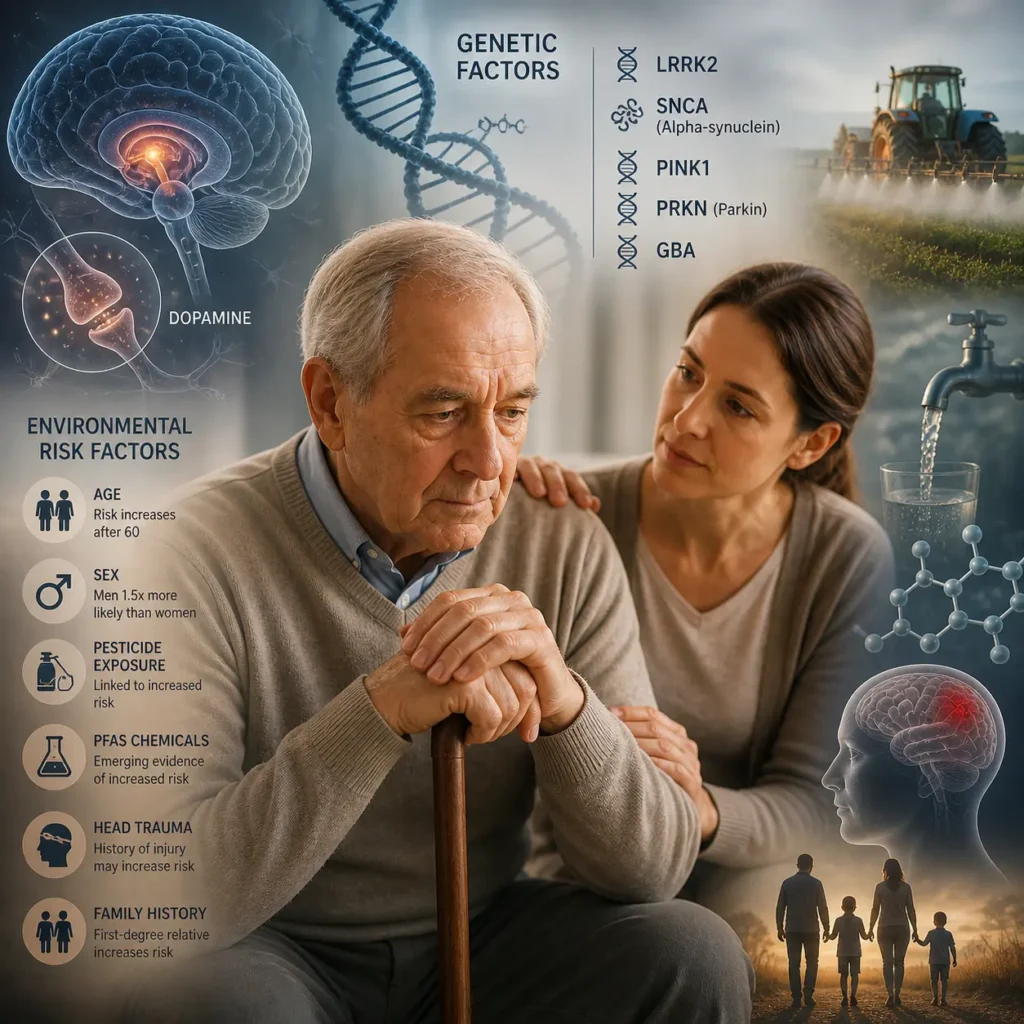
Parkinson’s disease results from the gradual loss of dopamine-producing neurons in the substantia nigra. What triggers this loss is not fully understood — but science points to a combination of genetic and environmental factors.
Genetic Risk Factors
About 10–15% of Parkinson’s cases are linked to an inherited gene mutation. Key genes involved include:
- LRRK2 (leucine-rich repeat kinase 2) — the most common genetic cause of Parkinson’s in certain ethnic groups
- SNCA (alpha-synuclein) — mutations cause abnormal protein clumps called Lewy bodies to form in brain cells
- PINK1 and PRKN (parkin) — linked to young-onset Parkinson’s disease (before age 50)
- GBA — a variant that increases risk of both Parkinson’s disease and Lewy body dementia
Genetic testing for Parkinson’s disease is increasingly available. A positive result does not guarantee you will develop the disease — but it can guide treatment decisions and eligibility for clinical trials.
Environmental Risk Factors
- Age — the biggest single risk factor; risk rises sharply after age 60
- Sex — men are about 1.5 times more likely to develop Parkinson’s than women
- Pesticide exposure — research has linked long-term exposure to certain pesticides with increased Parkinson’s risk
- PFAS chemicals — emerging evidence connects “forever chemicals” to adverse neurological effects, including Parkinson’s risk
- Head trauma — a history of traumatic brain injury is associated with higher risk
- Family history — even without identified gene mutations, having a first-degree relative with Parkinson’s increases risk
How Is Parkinson Disease Diagnosed?
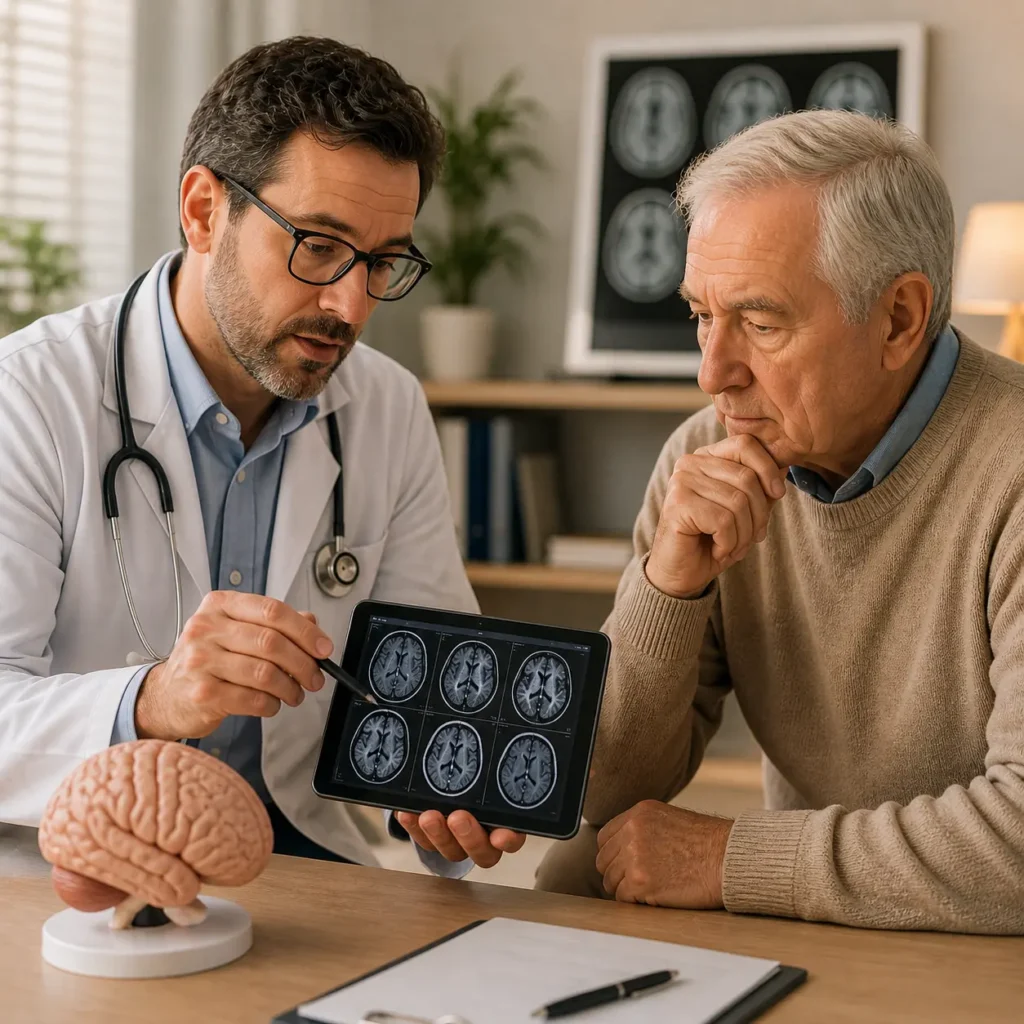
There is no single blood test or brain scan that can definitively diagnose Parkinson’s disease. Diagnosis is clinical — based on your medical history, symptoms, and a thorough neurological examination. Here is how a neurologist typically approaches diagnosis:
Step-by-Step Diagnostic Process
- Medical history review—the neurologist asks about your symptoms, when they started, your family history of neurological conditions, and any environmental exposures
- Neurological examination — testing muscle tone, tremor, balance, reflexes, gait, and facial expression
- Response to levodopa—a clear improvement in symptoms after taking levodopa strongly supports a Parkinson’s diagnosis
- Brain imaging (DaTscan or MRI)—DaTscan uses a radioactive tracer to visualize dopamine activity; MRI helps rule out other conditions like a stroke or brain tumor
- Rule out other conditions—atypical parkinsonism (MSA, PSP, DLB) can mimic Parkinson’s and must be excluded
The ICD-10 code for Parkinson’s disease is G20. US healthcare providers and insurance companies use this code for billing and medical records. Variants such as G20.A1 (without dyskinesia, without mention of fluctuations) help specify the stage and presentation for more precise documentation.
Parkinson Disease Treatment & Management Options
There is currently no cure for Parkinson’s disease. But the right treatment plan can dramatically improve quality of life, control symptoms, and slow functional decline. Treatment is highly personalized and typically combines medication, therapy, and in some cases, surgery.
| Treatment | What It Does |
|---|---|
| Levodopa + Carbidopa | Replaces dopamine in the brain. Most effective treatment for tremor, stiffness, and slow movement. |
| Dopamine Agonists | Mimic dopamine effects. Used in early-stage Parkinson’s to delay levodopa use. |
| MAO-B Inhibitors | Prevent dopamine breakdown. Help prolong dopamine action in the brain. |
| Deep Brain Stimulation (DBS) | Brain electrodes reduce tremor, rigidity, and motor fluctuations. |
| Physical & Occupational Therapy | Improve mobility, balance, and daily function. Helps maintain independence. |
| Speech Therapy (LSVT LOUD) | Improves voice volume and clarity. Treats speech problems in Parkinson’s. |
Deep Brain Stimulation (DBS) for Parkinson Disease
DBS is one of the most significant advances in Parkinson’s disease treatment in decades. A neurosurgeon places thin electrodes — typically in the subthalamic nucleus — connected to a small pulse generator (like a pacemaker) implanted near the collarbone. The device can be programmed to reduce specific symptoms.
DBS is most appropriate for people who have had Parkinson’s for at least 4 years, respond well to levodopa, but experience troublesome fluctuations or dyskinesia. It does not cure Parkinson’s or stop progression, but it can provide meaningful, long-lasting motor symptom relief. In the USA, DBS is covered by Medicare and most major insurance plans when medically indicated.
Exercises for Parkinson Disease
Exercise is one of the most powerful — and underused — treatments for Parkinson’s disease. Research shows that regular physical activity can slow disease progression, improve motor control, mood, sleep, and cognitive function.
Rock Steady Boxing — a popular non-contact boxing program specifically designed for Parkinson’s patients
Aerobic exercise — cycling (stationary or tandem), swimming, walking; aim for 150 minutes per week
Resistance training — weight training to combat muscle loss and improve strength
Balance training — tai chi, yoga, and dance reduce fall risk significantly
Stretching — counters rigidity and maintains flexibility
Parkinson Disease Diet: Foods That Help & Foods to Avoid
While no diet can cure Parkinson’s disease, what you eat can directly affect how well your medications work, your gut health, your energy, and your overall well-being. A Mediterranean-style diet is widely recommended by neurologists.
| ✅ Foods That Help | ❌ Foods to Avoid |
|---|---|
| Colorful vegetables (broccoli, spinach, beets) support brain health with antioxidants | High-protein foods near levodopa timing reduce medication absorption |
| Berries rich in neuroprotective antioxidants | Processed and fast food increase inflammation |
| Fatty fish (salmon, mackerel) omega 3s for brain function | Refined sugar promotes inflammation and energy crashes |
| Olive oil and nuts healthy anti inflammatory fats | Alcohol worsens balance, sleep, and medication response |
| Whole grains and legumes improve gut health | High saturated fat (red meat, full fat dairy) linked to poorer brain health |
| Green tea associated with lower Parkinson’s risk | Dehydrating drinks worsen constipation |
| Fermented foods (yogurt, kefir) support gut brain axis | — |

Living With Parkinson Disease: Quality of Life
A Parkinson’s diagnosis changes life — but it does not end it. Millions of Americans live full, meaningful lives with Parkinson’s disease. The key is building the right support system, staying informed, and being proactive about care.
Building Your Care Team
The best outcomes happen with a multidisciplinary care team. Your team should include a movement disorder neurologist, a physical therapist, an occupational therapist, a speech therapist, a mental health professional, and a social worker or care coordinator. At Venice Care, our integrated neurology team coordinates all of these specialists under one roof.
Mental Health & Parkinson’s
Depression affects up to 50% of people with Parkinson’s. It is not simply a reaction to the diagnosis — it is partly a neurological consequence of dopamine changes in the brain. Anxiety, apathy, and mood swings are also common. These are treatable. If you or a caregiver notice emotional changes, mention them at your next neurology appointment.
Technology & Wearable Tools
In 2026, a growing range of digital tools help people manage Parkinson’s day to day. Wearable devices can track tremor patterns and medication timing. Smartphone apps help monitor symptoms, medication schedules, and mood. Voice-assisted technology makes daily communication easier when speech is affected.
Support Groups & Community
Connecting with other people who have Parkinson’s — through national organizations like the Parkinson’s Foundation or the Michael J. Fox Foundation — provides emotional support, practical tips, and access to the latest research and clinical trials.
Parkinson Disease Life Expectancy & Prognosis
This is one of the most common and most important questions people ask after a Parkinson’s diagnosis. The answer is genuinely encouraging for most people.
Most people with Parkinson’s disease have a near-normal life expectancy — particularly those diagnosed in their 60s or later and who receive good medical care. Studies show that survival after diagnosis typically ranges from 10 to 20 years, and many people live even longer.
Factors that influence life expectancy with Parkinson’s disease include:
- Age at diagnosis — younger onset generally means a longer survival period
- Type of symptoms — tremor-dominant Parkinson’s tends to progress more slowly than those where rigidity and balance problems dominate
- Presence of dementia — cognitive decline, if it occurs, significantly affects prognosis
- Falls and injuries — a major cause of hospitalization and complications in advanced stages
- Overall health and comorbidities — heart disease, diabetes, and other conditions interact with Parkinson’s
- Access to specialist care — patients who see movement disorder neurologists consistently have better outcomes
Expert Parkinson Disease Care at Venice Care
At Venice Care, our neurology team specializes in the full spectrum of Parkinson’s disease care — from the moment of diagnosis through every stage of the journey. We combine clinical expertise with genuine compassion to help patients and families navigate this condition with confidence.
What Makes Venice Care Different
- Movement disorder neurologists — specialists with dedicated Parkinson’s training, not general practitioners
- Multidisciplinary team approach — neurologists, physio, occupational and speech therapists, and mental health professionals all coordinated in one place
- Personalized treatment plans — tailored to your specific symptoms, stage, lifestyle, and goals
- DBS evaluation and coordination — we work alongside leading neurosurgical partners for patients who may benefit from deep brain stimulation
- Ongoing monitoring and care adjustments — Parkinson’s changes over time; your care plan should too
- Caregiver support & education — because a diagnosis affects the whole family, not just the individual
Conclusion
Parkinson’s disease is progressive, but early diagnosis and the right treatment plan can make a major difference in quality of life. Recognizing symptoms early — including tremors, stiffness, slow movement, balance problems, sleep disruption, and cognitive changes — gives patients more options to manage the condition effectively.
At Venice Care, patients receive compassionate, individualized support for neurological conditions, including Parkinson’s disease. Under the guidance of Dr. Barry Gordon, the clinic focuses on symptom management, mobility support, pain relief, and improving daily function through evidence-based medical cannabis care.
Patients searching for terms like “medical marijuana doctor near me,” “cannabis doctor near me,” “medical card doctor near me,” or “medical marijuana Venice” often want clear answers about eligibility, treatment options, and long-term support. Venice Care helps qualifying Florida patients understand how to get a medical marijuana card in FL and whether Parkinson’s disease symptoms may qualify under the state program.
If you are dealing with Parkinson’s disease symptoms or caring for someone who is, working with an experienced cannabis clinic can help you explore additional treatment options designed to improve comfort, movement, sleep, and overall well-being.
Frequently Asked Questions about Parkinson Disease
What are the first signs of Parkinson’s disease?
Early symptoms usually include a resting tremor in one hand, subtle stiffness, slowed movement, and reduced arm swing when walking. Many people also notice smaller handwriting, softer voice, or loss of smell before motor symptoms appear.
What are the 5 stages of Parkinson’s disease?
Parkinson’s progresses from mild, one-sided symptoms (Stage 1) to full dependence (Stage 5). Early stages have minimal impact on daily life, mid-stage affects balance, and advanced stages require assistance with walking and daily activities.
What is the difference between Parkinson’s disease and parkinsonism?
Parkinson’s disease is a specific neurological condition. Parkinsonism is a broader term for a group of disorders that cause similar symptoms like tremor, stiffness, and slow movement but may have different underlying causes.
Is Parkinson’s disease genetic? Should I get tested?
Most cases are not strongly genetic. A small percentage are linked to gene mutations. Testing is usually only recommended if there’s a strong family history or early-onset Parkinson’s.
How long can you live with this disease?
Parkinson Disease itself is not usually fatal. Many people live for decades after diagnosis with proper treatment. Life expectancy depends on overall health, age at diagnosis, and how symptoms are managed.
What foods should I avoid with Parkinson disease?
Avoid processed foods, excess sugar, alcohol, and high-protein meals around medication times, as they can interfere with symptom control and medication absorption.
What is deep brain stimulation (DBS) and who is a candidate?
DBS is a surgical treatment where electrodes are placed in specific brain areas to control symptoms. It’s typically recommended for patients with significant motor fluctuations who no longer respond well to medication alone.
Can Parkinson disease cause high or low blood pressure?
Yes. Parkinson Disease can affect the autonomic nervous system, leading to low blood pressure when standing (orthostatic hypotension) or fluctuations in blood pressure.
Can Parkinson Disease be prevented?
There is no guaranteed prevention. However, regular exercise, a healthy diet, and avoiding toxins may reduce risk and support overall brain health.