
If you or someone you love has been living with epilepsy — especially when medications keep failing — you’ve probably asked the question: can cannabis actually help with seizures?
It’s not a fringe question anymore. Millions of Americans are turning to medical cannabis for seizures and epilepsy, and for the first time in history, the FDA has approved a cannabis-derived drug specifically for seizure disorders. The science is no longer speculative. But it is complicated.
This guide breaks everything down — the research, the risks, the difference between CBD and THC, the legal landscape in the USA, and when it makes sense to speak with a specialist about cannabis as part of your epilepsy treatment plan.
What Are Seizures and Epilepsy?
Epilepsy is a neurological disorder characterized by recurrent, unprovoked seizures — sudden bursts of electrical activity in the brain that disrupt normal function. Seizures can range from brief lapses in attention (absence seizures) to full convulsions. In the United States, approximately 3.4 million people live with epilepsy, making it one of the most common neurological conditions in the country.
Types of seizures include focal (partial) seizures that originate in one part of the brain, generalized seizures affecting both hemispheres simultaneously, tonic-clonic (formerly grand mal) seizures involving muscle stiffening and jerking, and absence seizures involving brief episodes of staring or unawareness.
The most challenging cases involve drug-resistant epilepsy, also called refractory epilepsy — a condition where seizures continue despite trying two or more appropriate antiepileptic medications. Roughly 30% of people with epilepsy fall into this category. For these patients and their families, the search for effective seizure control is urgent, and it’s precisely where the conversation around cannabis treatment for epilepsy has the greatest relevance.
How Cannabis Works for Seizures
To understand how cannabis helps seizures, you need to understand the endocannabinoid system (ECS) — a network of receptors throughout the brain and nervous system that regulates everything from mood and sleep to inflammation and neuronal excitability. The two primary cannabinoid receptors are CB1 (concentrated in the brain and nervous system) and CB2 (primarily in immune tissue).
Cannabis contains over 100 compounds called cannabinoids. The two most clinically studied are:
- CBD (cannabidiol) — non-intoxicating, primarily anti-inflammatory and neuroprotective
- THC (tetrahydrocannabinol) — the psychoactive compound; interacts strongly with CB1 receptors
When it comes to CBD vs THC for epilepsy, the evidence strongly favors CBD for seizure reduction. CBD appears to reduce neuronal hyperexcitability, modulate calcium channels involved in seizure propagation, and have anti-inflammatory effects in brain tissue — without producing a “high.” THC, on the other hand, presents a more complex and potentially riskier picture, which we’ll cover in detail below.
CBD for Seizures — Backed by Science
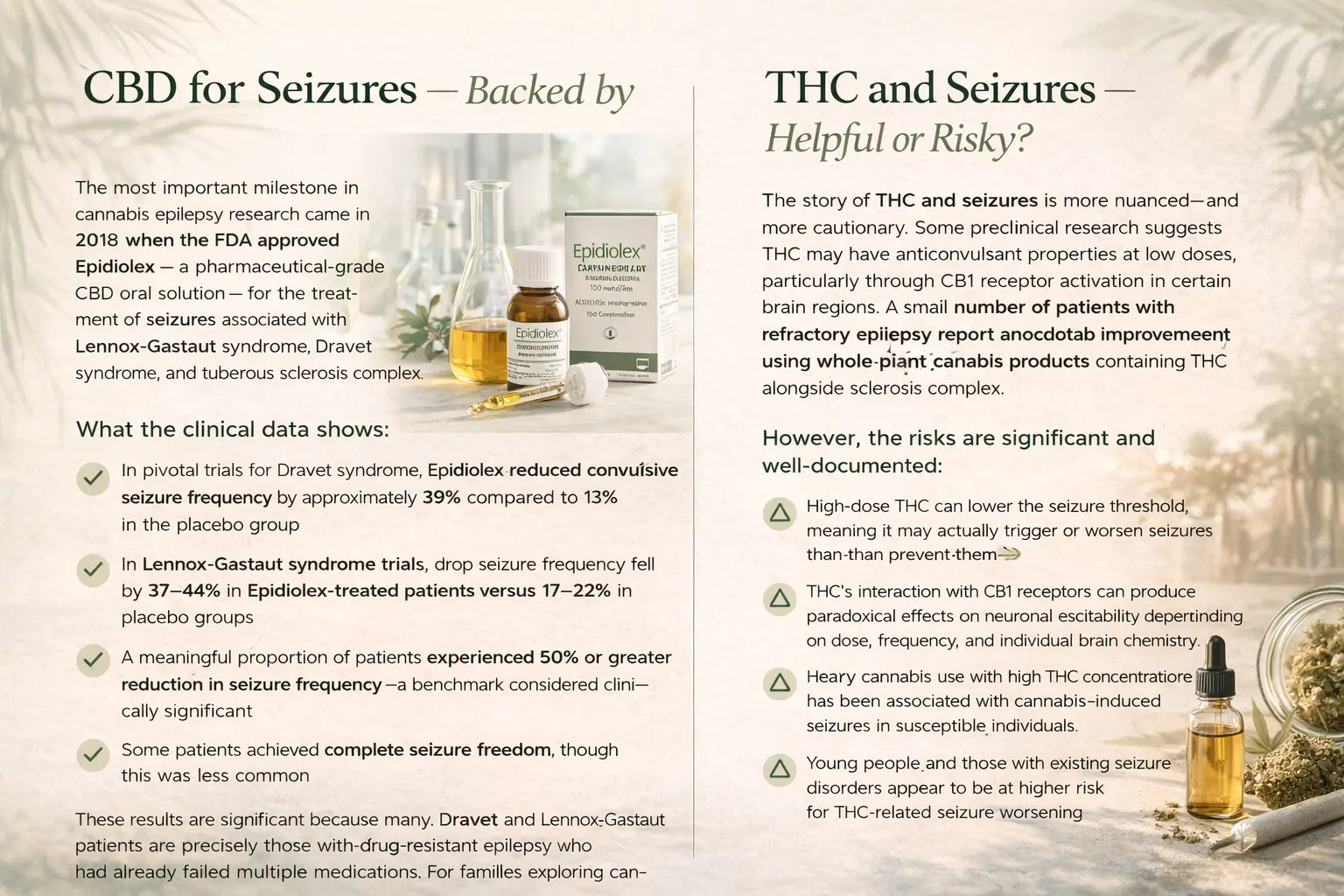
The most important milestone in cannabis epilepsy research came in 2018 when the FDA approved Epidiolex — a pharmaceutical-grade CBD oral solution — for the treatment of seizures associated with Lennox-Gastaut syndrome, Dravet syndrome, and tuberous sclerosis complex.
This was the first FDA-approved epilepsy drug derived from cannabis, and its approval was based on rigorous randomized, double-blind, placebo-controlled clinical trials.
What the clinical data shows:
- In pivotal trials for Dravet syndrome, Epidiolex reduced convulsive seizure frequency by approximately 39% compared to 13% in the placebo group
- In Lennox-Gastaut syndrome trials, drop seizure frequency fell by 37–44% in Epidiolex-treated patients versus 17–22% in placebo groups
- A meaningful proportion of patients experienced 50% or greater reduction in seizure frequency — a benchmark considered clinically significant
- Some patients achieved complete seizure freedom, though this was less common
These results are significant because many Dravet and Lennox-Gastaut patients are precisely those with drug-resistant epilepsy who had already failed multiple medications. For families exploring cannabis oil for seizures or CBD-based treatments, Epidiolex represents the gold standard — a rigorously tested, standardized, physician-prescribed option.
Beyond Epidiolex, real-world patient reports and observational studies have documented CBD’s benefits across broader epilepsy populations, including adults with focal seizures, though the clinical evidence base is strongest for childhood epilepsy syndromes.
THC and Seizures — Helpful or Risky?
The story of THC and seizures is more nuanced — and more cautionary.
Some preclinical research suggests THC may have anticonvulsant properties at low doses, particularly through CB1 receptor activation in certain brain regions. A small number of patients with refractory epilepsy report anecdotal improvement using whole-plant cannabis products containing THC alongside CBD.
However, the risks are significant and well-documented:
- High-dose THC can lower the seizure threshold, meaning it may actually trigger or worsen seizures rather than prevent them
- THC’s interaction with CB1 receptors can produce paradoxical effects on neuronal excitability depending on dose, frequency, and individual brain chemistry
- Heavy cannabis use with high THC concentrations has been associated with cannabis-induced seizures in susceptible individuals
- Young people and those with existing seizure disorders appear to be at higher risk for THC-related seizure worsening
The honest answer is: CBD is the cannabinoid with demonstrated, FDA-backed seizure-reducing evidence. THC’s role remains unclear at best, potentially harmful at worst — especially without medical supervision. This is why most epilepsy specialists who recommend medical cannabis for epilepsy focus heavily on high-CBD, low-THC formulations.
Can Cannabis Cause Seizures?
This is one of the most searched questions in this space — and it deserves a direct answer: yes, under certain conditions, cannabis can cause or worsen seizures.
The primary risk factors include:
High-THC products: Recreational cannabis today often contains THC concentrations of 20–30% or higher — far above anything used in clinical research. At these concentrations, THC can overstimulate CB1 receptors and provoke seizure activity in susceptible individuals.
Edibles and delayed onset: One particularly dangerous scenario involves cannabis edibles. Because edibles are metabolized through the liver into a more potent THC compound (11-hydroxy-THC), and because their effects are delayed by 1–2 hours, users may consume excessive amounts while waiting for the effect — leading to acute THC toxicity, which in rare cases triggers seizures. Cases of edibles and seizures have been documented in emergency departments, particularly in states with legal recreational cannabis.
Cannabis withdrawal: Chronic, heavy users who abruptly stop using cannabis may experience withdrawal seizures, similar to benzodiazepine or alcohol withdrawal, due to disruption of the endocannabinoid system’s equilibrium.
Drug interactions: THC and CBD both interact with cytochrome P450 liver enzymes, which process many antiepileptic drugs. CBD, in particular, can significantly raise plasma levels of certain seizure medications like clobazam — leading to increased side effects or toxicity if dosages aren’t adjusted.
The takeaway: cannabis is not uniformly safe for people with epilepsy. Product type, THC concentration, delivery method, and individual factors all matter enormously. Medical supervision is essential.
Benefits of Cannabis for Epilepsy
For the right candidate — particularly those with drug-resistant epilepsy — the benefits of medical cannabis for epilepsy can be transformative:
Seizure frequency reduction: The most documented benefit. In well-designed trials, CBD-based treatment reduces seizure frequency by 30–50% in many patients who had previously failed multiple antiepileptic drugs.
Seizure severity: Even when seizures aren’t eliminated, many patients and caregivers report that seizures become shorter, less severe, and recovery is faster.
Quality of life: Reduced seizure burden often translates to improved sleep, better cognitive function, greater independence, and reduced anxiety — all of which are major quality-of-life concerns for epilepsy patients.
Tolerability: For many patients, CBD-based treatments are better tolerated than traditional antiepileptic medications, which frequently cause sedation, cognitive impairment, mood changes, and liver toxicity.
Pediatric epilepsy: Some of the strongest evidence for cannabis in epilepsy comes from pediatric populations, particularly children with Dravet syndrome — a devastating epilepsy that begins in infancy and is notoriously treatment-resistant. For many of these families, CBD has provided seizure control where nothing else worked.
Risks and Side Effects
Even CBD-based treatments carry risks that patients and families should know:
- Drowsiness and fatigue are the most common side effects, occurring in roughly 25–30% of patients
- Gastrointestinal symptoms including nausea, diarrhea, and reduced appetite are reported, particularly at higher doses
- Elevated liver enzymes have been observed in some patients on Epidiolex — especially when taken alongside valproate — requiring regular liver function monitoring
- Drug interactions with other antiepileptic medications, including clobazam, valproate, and topiramate, can alter drug blood levels in clinically significant ways
- Long-term effects of chronic CBD use in children are still being studied, and caution is warranted with very young patients
This reinforces the core message: cannabis treatment for epilepsy is not a DIY intervention. Even “natural” CBD products require medical supervision to manage interactions and monitor for side effects.
Who Should Consider Cannabis for Seizures?
The strongest candidates for cannabis-based epilepsy treatment are:
- Adults and children with drug-resistant (refractory) epilepsy who have failed two or more appropriate antiepileptic medications
- Patients with specific epilepsy syndromes where CBD has the strongest evidence base: Dravet syndrome, Lennox-Gastaut syndrome, and tuberous sclerosis complex
- Patients seeking to reduce side effects from conventional seizure medications
- Those with epilepsy-related anxiety or sleep disruption who may benefit from CBD’s broader neurological effects
Cannabis-based epilepsy treatment is generally not recommended as a first-line therapy — not because it doesn’t work, but because robust evidence exists for first-line antiepileptic drugs, and cannabis remains under-studied as an initial monotherapy. However, in refractory cases, it represents a medically credible, increasingly supported option.
Pediatric vs. adult cases: The evidence base for pediatric epilepsy (particularly CBD for specific childhood syndromes) is stronger than for adult focal or generalized epilepsy. In adults, cannabis-based treatment is more commonly considered as an adjunctive therapy alongside existing medications.
Legal Status in the USA
The legal landscape for medical cannabis in the USA is complex and varies significantly by state:
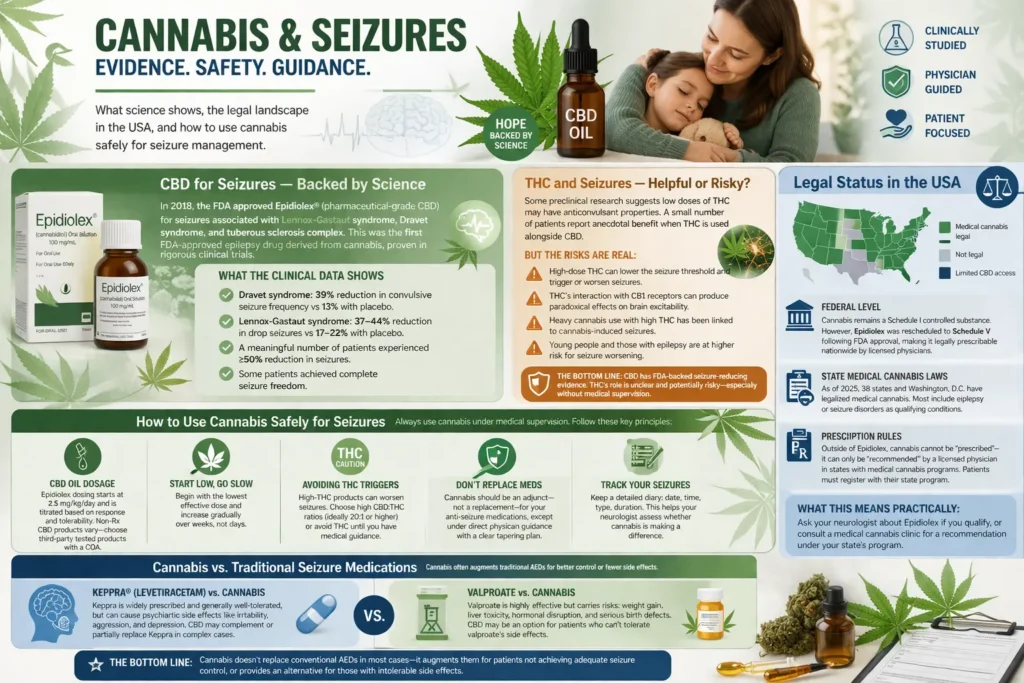
Federal level: Cannabis remains a Schedule I controlled substance under federal law. However, Epidiolex (pharmaceutical CBD) was rescheduled to Schedule V following its FDA approval — making it legally prescribable nationwide by licensed physicians.
State medical cannabis laws: As of 2025, 38 states and Washington D.C. have legalized medical cannabis, and the majority include epilepsy or seizure disorders as qualifying conditions. Some states specifically added intractable epilepsy as a qualifying condition before broader legalization.
Prescription rules: Unlike most prescription medications, cannabis cannot be “prescribed” in the traditional sense outside of Epidiolex — it can only be “recommended” by a licensed physician in states with medical cannabis programs. Patients must register with their state’s medical cannabis program to legally obtain products.
What this means practically: If you’re interested in cannabis treatment for seizures, you have two legal pathways in most states: ask your neurologist about Epidiolex if you qualify, or consult with a medical cannabis clinic to obtain a medical cannabis recommendation under your state’s program.
How to Use Cannabis Safely for Seizures
If you’re exploring cannabis for seizure management under medical supervision:
CBD oil dosage: FDA-approved Epidiolex dosing begins at 2.5 mg/kg/day and is titrated upward based on response and tolerability. Non-pharmaceutical CBD products vary widely in quality and concentration — always choose third-party tested products with a verified certificate of analysis (COA).
Start low, go slow: This is the cardinal rule of cannabis medicine. Begin at the lowest effective dose and increase gradually over weeks, not days.
Avoiding THC triggers: For epilepsy patients specifically, high-THC cannabis products should be approached with extreme caution — or avoided entirely — until there is clear medical guidance. If using whole-plant products, choose formulations with a high CBD:THC ratio (ideally 20:1 or higher).
Never replace prescribed medications without medical guidance: Cannabis should be introduced as an adjunct to — not a replacement for — existing antiepileptic therapy, except under direct physician supervision with a clear tapering protocol.
Track your seizures: Keep a detailed seizure diary. Date, time, type, duration — this data is invaluable for your neurologist in assessing whether cannabis treatment is working.
Cannabis vs. Traditional Seizure Medications
How does cannabis compare to established antiepileptic drugs (AEDs)?
Keppra (levetiracetam) vs. cannabis: Keppra is one of the most widely prescribed AEDs and is generally well-tolerated, but it is associated with psychiatric side effects including irritability, aggression, and depression in a significant minority of patients. CBD-based treatment has a different side effect profile — predominantly sedation and GI issues — and may complement or partially replace Keppra in complex cases.
Valproate vs. cannabis: Valproate is highly effective across many seizure types but carries significant risks including weight gain, liver toxicity, hormonal disruption, and serious teratogenicity (birth defects). CBD-based treatment is often considered for patients who cannot tolerate valproate’s side effects.
The bottom line: Cannabis doesn’t replace conventional AEDs in most cases — it augments them for patients not achieving adequate seizure control, or provides an alternative for those with intolerable side effects.
When to See a Specialist
You should urgently consult a neurologist or epilepsy specialist if:
- You’ve tried two or more seizure medications without adequate seizure control
- Your seizures are increasing in frequency or severity
- You’re experiencing intolerable side effects from current medications
- You’re pregnant, planning pregnancy, or treating a child, and seeking alternatives
- You’re currently using cannabis products alongside antiepileptic drugs without a physician’s knowledge
Don’t wait. Drug-resistant epilepsy is a medical emergency that deserves aggressive, expert management — and today that includes exploring cannabis-based options with a qualified specialist.
Why Choose VeniceCare for Cannabis Treatment
If you’re ready to explore medical cannabis for seizures with proper medical guidance, VeniceCare offers a dedicated cannabis treatment program staffed by physicians experienced in epilepsy and neurological conditions.
At VeniceCare, you’ll receive:
- Personalized evaluation of your seizure history, current medications, and treatment goals
- Expert guidance on the right cannabis formulations — including CBD-dominant protocols appropriate for epilepsy
- Ongoing monitoring for drug interactions, side effects, and treatment response
- Help navigating your state’s medical cannabis program, including recommendation letters and dosing guidance
- Coordination with your existing neurologist to ensure integrated, safe care
Cannabis for epilepsy isn’t a last resort anymore — it’s a legitimate medical option with FDA-backed science behind it. The question is whether you’re getting expert guidance to use it safely and effectively.
Frequently Asked Questions
Does cannabis stop seizures immediately?
No. Cannabis — even CBD — does not typically stop a seizure in progress in the way that emergency benzodiazepines like diazepam do. CBD’s anticonvulsant effects are cumulative and develop over weeks of consistent dosing. It is not a rescue medication for acute seizures.
Is CBD better than THC for epilepsy?
Yes, based on current evidence. CBD has FDA-approved status for specific seizure disorders, with well-documented efficacy in randomized controlled trials. THC’s role in epilepsy management is unclear, inconsistent, and associated with potential seizure-worsening effects at high doses. For epilepsy specifically, high-CBD, low-THC formulations are strongly preferred.
Can weed trigger seizures?
Yes, it can. High-THC cannabis products — including potent concentrates and edibles — can lower the seizure threshold and trigger seizures in susceptible individuals, including those with pre-existing epilepsy. Cannabis withdrawal in heavy users can also cause seizure activity. This is distinct from the therapeutic effects of medically supervised, CBD-dominant cannabis treatment.
Is cannabis legal for epilepsy in the US?
It depends on the form and your state. Epidiolex (pharmaceutical CBD) is FDA-approved and legal nationwide. Medical cannabis (broader cannabis products) is legal in 38+ states for qualifying conditions, which typically include epilepsy or seizure disorders. Recreational cannabis is legal in a smaller number of states. Consult with a medical cannabis clinic in your state to understand your specific options and legal protections.
What is the best cannabis strain for seizures?
For therapeutic use in epilepsy, “strains” are less relevant than cannabinoid profile and quality. You want high-CBD, very low-THC products from verified, third-party-tested sources. Pharmaceutical Epidiolex is the only FDA-evaluated option. For non-pharmaceutical CBD, look for products specifically formulated for medicinal use with verified CBD concentrations and negligible THC.
Can children use cannabis for seizures?
Yes—some of the strongest evidence for cannabis in epilepsy is specifically in pediatric patients with Dravet syndrome and Lennox-Gastaut syndrome. Epidiolex is FDA-approved for patients as young as 1 year old for these conditions. A pediatric neurologist with expertise in epilepsy should always manage pediatric cannabis treatment.
This article is for informational purposes only and does not constitute medical advice. Always consult a qualified healthcare provider before making changes to your seizure treatment plan.